A parent’s guide to choosing
Sibling activities for different ages: share a theme, keep separate roles
Siblings can enjoy the same afternoon without doing the same task. Begin with the youngest child's card and setup, then decide how an older sibling might join the theme. Shared play works more comfortably when everyone knows what belongs to them, what is shared and where an adult will be. An older child can take part without being made responsible for supervising a younger one.
Browse free activity previewsStart with today
Choose a starting point
The youngest needs you beside them
A shared theme with separate age-appropriate tasks
Keep your attention on the youngest child's supervision requirements.
Both children want to lead
Storytelling or pretend play with distinct roles
Agree which choices are shared before the first disagreement.
Their materials cannot be shared
Separate building spaces or an observation idea
Keep older-child supplies beyond the younger child's access.
One child wants to leave the game
An idea that can continue with fewer players
Decide how to pause or finish without requiring everyone to stay.
Begin with the youngest child's setup
For ages 1–2, choose a card from that age band and plan to participate. For ages 3–4, check how much demonstration and ongoing help the chosen card needs. Do that before arranging an older sibling's role. A nearby adult cannot automatically manage two activities with conflicting supervision needs, even when the children are in the same room.
Consider the youngest child's access to the whole space. An older child's materials may need a separate area or another time. If you cannot provide the attention each card requires, choose a different pairing or play with one child at a time. Shared play is an option, not a requirement.
Find a common thread, then separate the jobs
Storytelling and pretend play can give siblings a common subject while leaving room for different contributions. One child may want to choose a character while another prefers describing the setting. Building can mean separate creations in the same imagined place. Observation games offer a shared thing to notice without requiring matching results. Choose from the previews before promising a particular arrangement.
For ages 5–6, offer a clear role and a visible stopping point. Children aged 7–9 or 10–12 may prefer their own role or an additional challenge from their age band. Ask them rather than assigning the oldest to be the helper. Children can take part together using different cards and materials.
Agree on what is shared
Decide whether supplies, space and decisions belong to everyone or to individual players. Separate working areas can make that boundary clear. A shared theme does not make every creation communal. Ask before changing another child's structure, drawing on their page or taking over their chosen character.
If both children want the same role, consider separate versions or another activity instead of insisting that one gives way. Keep the first round short enough to discover whether the arrangement works. You can change the plan when a child looks uncomfortable or asks to stop. The aim is a workable invitation, rather than keeping siblings together at any cost.
Keep adult attention in the plan
An older sibling can offer ideas or cooperate, but that does not replace an adult's supervision. Read each card's label and keep responsibility with the adult. The collection below selects indoor group-play previews without hazard badges; that filter does not establish that a setup is suitable for every sibling combination. Check each child's age, the materials and the way the room will be used.
Decide how you will pause if one child needs you. Give children somewhere to leave their work while you help, and choose an ending that does not depend on unanimous agreement. Afterward, ask what each child would keep next time. A short shared session followed by separate choices may fit better than extending an unwanted game.
From the activity library
Find a real activity to try
Indoor storytelling, pretend-play, building and observation previews marked for playing with other children, across all five age bands. Start with the youngest child's card and check each participant's setup and adult supervision needs.
You know your child best. Adapt or skip anything that doesn’t feel right, and supervise as noted. Read the full instructions and safety guidance before starting.
Previews are free to browse
Full steps, the tip and safety note cost 3 credits to unlock for an ordinary library card. Complete sample activities are free.
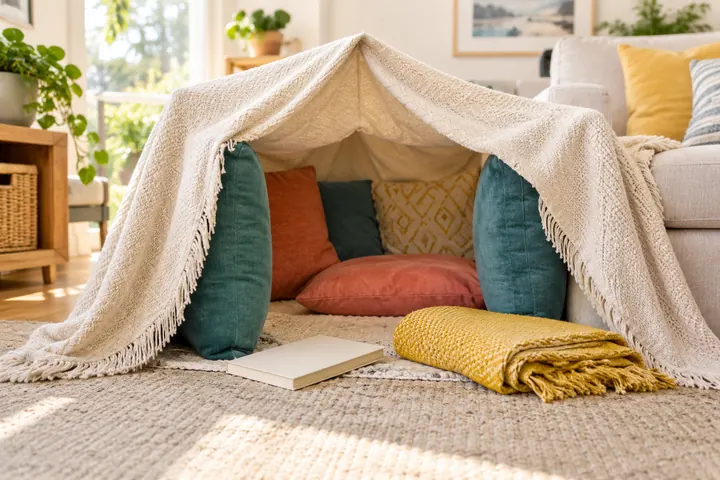

Blanket Fort Reading Nook
- 60 min
- 5 min prep
- Things at home
- Some tidying